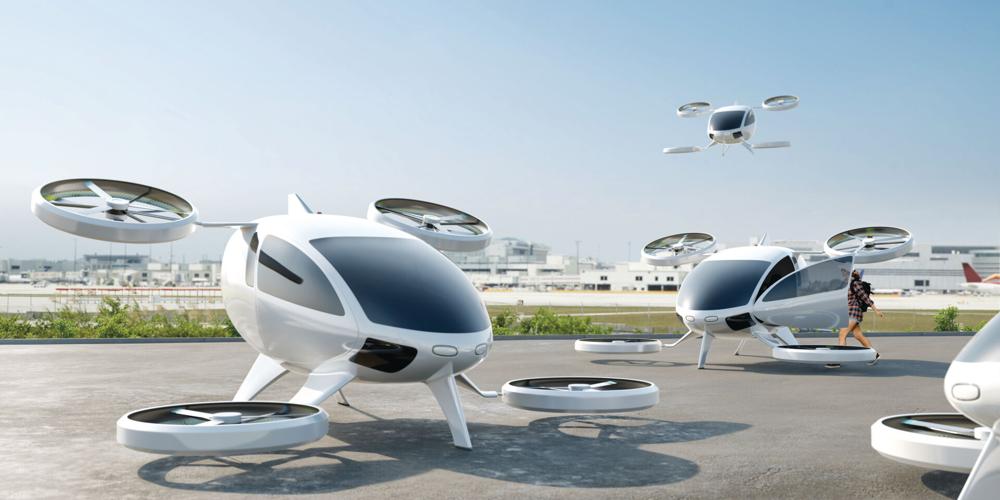





Advanced air mobility (AAM) is on the horizon as a new way to transport passengers and cargo across short distances. By providing cost-effective services in and around cities, AAM has the potential to become as ubiquitous as Uber and Lyft. The key to achieving this is making AAM autonomous.

Nand Kochhar, VP of Automotive & Transportation, Siemens Digital Industries Software
Many AAM companies are committed to making their aircraft capable of uncrewed flight, whether it is included from the initial launch or implemented in redesigns down the line. However, introducing uncrewed AAM carries myriad challenges and complexities. Just how autonomous do these aircraft need to be? How can companies make them safe to operate in public spaces?
Fortunately, the automotive industry has been developing autonomous vehicles for years now, achieving great success in doing so. Autonomous cars are now a frequent sight in multiple cities across the United States. There is much AAM companies can learn from the automotive industry for their own pursuit of autonomous aircraft, addressing the aforementioned concerns and recognizing the importance of digital transformation in turning autonomous vehicles into a reality.

Todd Tuthill, VP of Aerospace & Defense, Siemens Digital Industries Software
Defining Autonomy
The automotive industry measures the autonomous capabilities of a vehicle in five levels. Level 1 marks a vehicle that can control a single function, such as braking in linear motion. The levels increase from there along with the number of autonomous capabilities. By Level 3, a vehicle can be mostly autonomous but still requires a human in the driver’s seat, while in Level 4 a vehicle can operate itself without a human except in emergency situations. Level 5 is the Holy Grail of vehicle autonomy, requiring no human operation whatsoever.
The good news for AAM is that the aerospace industry is already somewhere between levels 3 and 4. After all, 95% of all commercial flight uses some level of autopilot. Typically, human pilots perform takeoffs and landings and monitor the rest of the flight for safety. The foundation to implement autonomous flight into AAM fleets is already there. Companies simply need to determine what that looks like for their aircraft. For example, Wisk is an AAM company that plans to have remote human supervisors monitor groups of aircraft, ready to step in if something goes wrong. This easily falls into Level 4 autonomy.
The issue is not designing for the last 5% or teaching an AAM to take off and land. Rather, the challenge is how to design a computer to respond correctly in an ambiguous or unexpected situation—as Captain Chesley “Sully†Sullenberger did when he landed a disabled plane in the Hudson River and saved the lives of 155 people aboard a US Airways flight in 2009.
If an autonomous car breaks down, in most instances, it can simply pull over to the side of the road and wait for help. If an uncrewed AAM carrying passengers fails in the air, the consequences can be much more devastating. As a result, AAM companies will need to go the extra mile to introduce further redundancy before they can get an autonomous aircraft certified. They need to prove to regulators that the aircraft can direct itself out of emergency situations or, in other words, act at Level 5 autonomy.
Digital Transformation is Key
Ensuring autonomous AAM vehicles are safe to operate will require key insights provided through digital transformation. Incorporating tools such as the digital twin, the automotive industry has utilized such transformation to achieve success in building autonomous vehicles. Digital transformation is already underway in most aerospace companies, and will be critical to the pursuit of AAM.
With the digital twin, companies can bring the physical world into the digital, creating a virtual representation of a product to test and simulate before building the physical prototype. Here, engineers can determine how an uncrewed AAM vehicle could behave and prove its reliability, all in the safety of a digital environment. As a result, engineers can find and remove flaws in a design earlier and deliver an optimized product to market faster.
Digital transformation also holds many benefits beyond design. From manufacturing to operational support, digital transformation can intertwine and share data from across the product lifecycle. For example, data taken from the operation of autonomous AAM vehicles can be fed back to design, leading to improved performance and safety for the next generation of aircraft. The full potential of digital transformation is immense and can benefit the development of autonomous AAM throughout the entire process.

Many AAM companies have plans to make their aircraft capable of uncrewed flight, without human pilots onboard.Â
Making AAM autonomous comes with multiple challenges, yet the groundwork for overcoming these challenges already exists. Between insights into autonomous vehicles already accrued by the automotive industry and the benefits of digital transformation, the growing AAM sector has the tools and knowledge necessary to bring uncrewed AAM to life in a manner safe for the public.